Star Count Activity (due as part of Quiz 2)
Brief Overview
of Activity: Determine the number
of stars visible to the
naked eye by collecting sample star counts over a small area of the sky.
Required Items: a ruler (marked in centimeters), one small cardboard tube (the center tube from a roll of toilet paper is ideal. Note: the length of the tube must be greater than its width.), red-light flashlight (or tape a piece of red cellophane or plastic over a white-light flashlight). Using a regular white-light flashlight will interfere with your night vision.
Number
of Observations needed: 3, each at a different
location as
detailed below. Note: 2 observations will do if 3 are not possible.
Timing of Observations: clear, dark moonless night
Procedure:
Preparation: Carefully
measure the length of your cardboard tube. Make your measurement to the
nearest
0.1 centimeter
and record here: L = _______ cm.
Next, carefully measure
the diameter of your
cardboard tube. Make your measurement to the nearest 0.1 centimeter
and
record
here: D = _______ cm.
Observation: On a clear, dark, moonless night, allow a few minutes for your eyes to adapt to the dark, then hold the tube up to your eye then count and record the number of stars that you can see through the tube. Hold the tube steady, with your eye at the center of the tube's opening, during each star count. Do this ten times, choosing random areas of the sky to measure. Be sure to sample all directions equally.
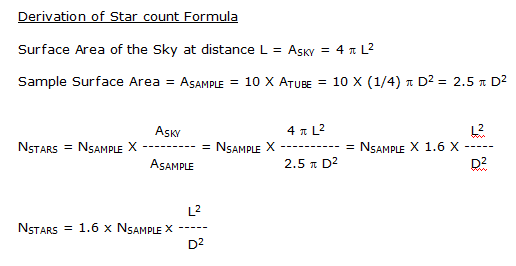
Calculation: You can estimate the total number of naked-eye stars visible in the night sky by using: the length (L) of the cardboard tube, the diameter (D) of the cardboard tube, and the number of stars in your sample (NSAMPLE). Use your measurements and the formula below to estimate the number of naked-eye stars visible in the night sky. For anyone interested, a derivation of this formula can be found at the bottom of the page.
Your answer is an estimate of the total number of stars in the night sky that are visible to the naked eye at this particular location.
Follow
this procedure three times: once in a city, once in a rural location
away from
city lights and once in another location. In the end, you should have
three
different estimations of stars for three different locations.
Make
sure you record the locations, dates, and times of your three sets of
observations on the next page.
Star Count Observations and Data
Location of Observation (1): ____________________________________________
Date ____________________Time __________ pm
Total
Number of Sample Stars Observed ___________
Calculated Number of Visible Stars ___________
Location of Observation (2): ____________________________________________
Date
____________________Time __________ pm
Total Number of Sample Stars Observed ___________
Calculated Number of Visible Stars ___________
Location of Observation (3): ____________________________________________
Date
____________________Time __________ pm
Total Number of Sample Stars Observed ___________
Calculated
Number of Visible Stars _________________
If you want to know where the formula comes from.... continue reading below...