Apparent Motion of Stars


Long Exposure Photo Showing Circumpolar Star Trails

Notes: This is the kind of shot you would get with your camera if you were to take a long exposure photo (leave the camera's shutter open for a long time). This shot was taken in the direction of the North Star. Notice how all of the "celestial objects" seem to move in circles around the North Star... although there is a bit of distortion due to the camera lens that seems to elongate some of the "orbits". The long straight streaks of light are from aircraft taking off from a nearby airport.

stuff 


Apparent Retrograde Motion of Planets


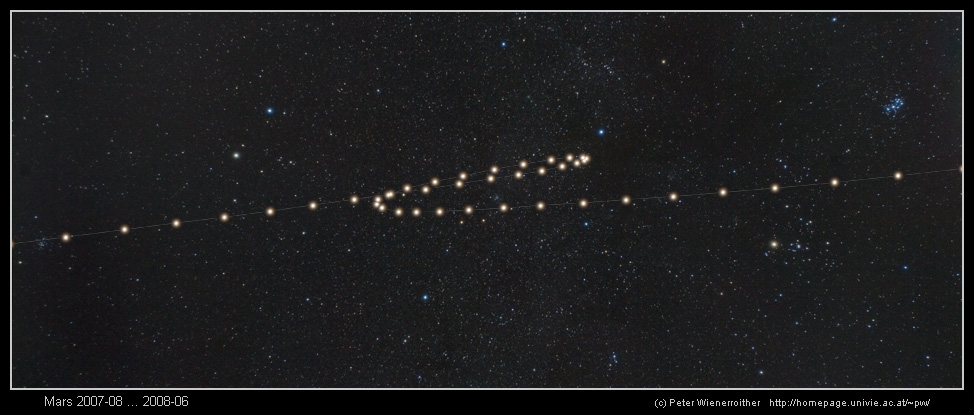
Sequence showing the Apparent Retrograde Motion of Mars

Notes: There are two images below. The first is an animation composed of images of Mars as it moved through the night sky in 2007 and 2008. The exact same part of the sky is photographed so that only the motion of Mars is apparent. Notice that Mars moves first towards the left, then slows down and moves up towards the right, and finally resumes its path towards the left. The second image shows that Mars traces out a loop during this motion. This odd motion confused ancient peoples and understanding the true nature of this motion lead to understanding the true nature of planetary orbits. 

stuff


Final shot with path highlighted


Trying to explain Retrograde Motion in the Earth-Centered Model

Circular Motion compared to Circular Motion with an Epicycle 

Notes: Theses animations contrast purely circular motion on the left against circular motion with an epicycle added on the right. Follow along with the motion on the right. Can you see the red planet forming a loop in its motion as seen from the blue planet?


Trying to explain Retrograde Motion in the Sun-Centered Model

Sun-Centered Model with Circular Motion - Two Perspectives 

Notes: Below are two animations of the exact same motion - shown from two different perspectives. The animation on the left shows the motion from the prespective of the Sun - both planets orbit in circles at different distances and at different speeds. How would this motion appear to someone on the blue planet? The animation on the right shows how this motion would appear - the Sun moves in a circle while the red planet appears to do a retrograde loop motion.


Sun-Centered Model with Elliptical Motion

Notes: The correct explanation for retrograde motion is seen in the animation below. Planets actually orbit in elliptical orbits - not circular orbits. In an elliptical orbit the object's speed changes throughout its orbit - moving faster when close to the Sun and moving slower when far from the Sun. Observe the two planets below. Notice that the blue planet moves faster in its orbit tan the red planet - due to it being closer to the Sun. The result is similar to that seen in the figure above - but now the relative speeds are correct. A person on the blue planet would observe the red planet undergo a retrograde loop similar to the one seen in the figure above.


Dr. Bob's Stuff - All Rights Reserved